Om Namasivaya nama:
Today we discussed first sloka whereby Sri Adi Sankara Bhagavathpadar giving his humblest Pranam to his Guru Dev Sri Govinda Gurupadar.
Please click the link to listen full discourse.
http://www.4shared.com/mp3/xHe0HHYF/081108-195311.html
Friday, August 9, 2013

Saturday, August 3, 2013
VIVEKA CHOODAMANI - CHAPTER 1 : INTRO 4 : AUG 02-2013
Om Namasivaya nama:
Today we revised Sadhana Chathushtayam (Viveka, Vairaghyam, Mumukshuthwam, Shadka Sampathy), Shadka Sampathy (Sama, Dhaama, Uparathy, Thitheeksha, Sradha and Saamadhaanam) followed by Dos and Don'ts (Niyamas and Yamas):
All Vedanthik students must practice these 10 commandments without fail to understand and practice Vedik Life. These qualities are the foundations of Sanathana Dharma.
Niyamas: (Dos)
1. Saucham (Purity in all respects)
2. Santhosha (Peace of mind in all respects)
3. Thapas (Meditating, fasting and self enquiry)
4. Sadhyayanam (Spiritual Study)
5. Iswara Pramidhanam (Surrender to God)
Yamas:(Don'ts)
1. Himsa (No voilance manasa/vaacha/karmana)
2. Asathyam (avoidance of lie)
3. Stheyam (avoidance of robing and cheating)
4. Maidhunam (No excessive sexual activities)
5. Parigraham (No over possession of wealth and accumulation)
Please click below link to listen full story. I suggest every listener take a print out of these and place it on the wall to follow and get reminded.
http://www.4shared.com/mp3/v5YgLphb/080408-200101.html
Today we revised Sadhana Chathushtayam (Viveka, Vairaghyam, Mumukshuthwam, Shadka Sampathy), Shadka Sampathy (Sama, Dhaama, Uparathy, Thitheeksha, Sradha and Saamadhaanam) followed by Dos and Don'ts (Niyamas and Yamas):
All Vedanthik students must practice these 10 commandments without fail to understand and practice Vedik Life. These qualities are the foundations of Sanathana Dharma.
Niyamas: (Dos)
1. Saucham (Purity in all respects)
2. Santhosha (Peace of mind in all respects)
3. Thapas (Meditating, fasting and self enquiry)
4. Sadhyayanam (Spiritual Study)
5. Iswara Pramidhanam (Surrender to God)
Yamas:(Don'ts)
1. Himsa (No voilance manasa/vaacha/karmana)
2. Asathyam (avoidance of lie)
3. Stheyam (avoidance of robing and cheating)
4. Maidhunam (No excessive sexual activities)
5. Parigraham (No over possession of wealth and accumulation)
Please click below link to listen full story. I suggest every listener take a print out of these and place it on the wall to follow and get reminded.
http://www.4shared.com/mp3/v5YgLphb/080408-200101.html
Saturday, July 27, 2013
VIVEKA CHOODAMANI - CHAPTER 1 : INTRO 3 : JULY 26-2013
Om Namasivaya nama:
Today we discussed about introduction part, where the topic was Shad Sampathy besides Viveka, Vairaghya, Mumukshuthwam. Those 6 qualities or wealth of human were : Sama (Control over mind), Dhama (Control over sensory organs), Uparathi (Following own duties/swadharma), Thitheksha (Control over Cold and Hot and Happiness and Sorrows), Sradha (Faith in Guru's advise and scriptures) & Saamdhanam (Concentration or sound meditation).
please click the link for detailed discussion.
http://www.4shared.com/mp3/qp_59Vuh/072808-193511.html
Today we discussed about introduction part, where the topic was Shad Sampathy besides Viveka, Vairaghya, Mumukshuthwam. Those 6 qualities or wealth of human were : Sama (Control over mind), Dhama (Control over sensory organs), Uparathi (Following own duties/swadharma), Thitheksha (Control over Cold and Hot and Happiness and Sorrows), Sradha (Faith in Guru's advise and scriptures) & Saamdhanam (Concentration or sound meditation).
please click the link for detailed discussion.
http://www.4shared.com/mp3/qp_59Vuh/072808-193511.html
Saturday, July 20, 2013
VIVEKA CHOODAMANI - CHAPTER 1 - INTRO 2 : JUL 19-2013
Om Namasivaya Nama:
It is advisable to understand the qualifications required to learn and master Vedantha Thathwams. Therefore Sadguru recommend the student of vendatha to acquire the knowledge of Thathwa Bodham, Athma Bodham and Athma Jgnanam before entering in to the ocean of Vedantha Philosophy. Therefore first we will learn Thathwa Bodham. The foundation of Thathwa Bodam structured as Saadhana Chathushtayam. They are:
1. Viveka (Disrimination) - control over mind
2. Vairaghyam (Dispassion) - control over sensory
3. Mumukshuthwam (Desires) - freedom from worldly affairs in other words mukthi for aathma
4. Shadga-sambathy (Discipline) - Those 6 wealth/sambath are: Sama, Dhama, Uparathi, Thitheeksha, Sradha and Saamadhanam.
Please click this link to listen full discourse.
Saturday, July 13, 2013
VIVEKA CHOODAMANI - CHAPTER 1 : INTRO 1 - JUL 12-2013
Om Namasivaya Nama
Today being one of the most auspicious day Aashaada Navarathri, divine mother blessed us to start Viveka
Choodamani pravachanam. My humble salutations to Guru Mandalam. What is Vivekam is explained as the power of discrimination between real and unreal.
Please click the link to listen fully story.
http://www.4shared.com/mp3/55lmDv7F/071408-173904.html
Today being one of the most auspicious day Aashaada Navarathri, divine mother blessed us to start Viveka
Choodamani pravachanam. My humble salutations to Guru Mandalam. What is Vivekam is explained as the power of discrimination between real and unreal.
Please click the link to listen fully story.
http://www.4shared.com/mp3/55lmDv7F/071408-173904.html
Saturday, July 6, 2013
SAPTHA RISHIS IN HUMAN BODY 3 TO 7 : JUL 05-2013
Om Namasivaya nama:
Today we talked about the remaining Saptha Rishis vis: Pulasthyan, Pulahan, Kruthu & Vasishtan:
Pulasthyan represents as Karma Devathas in other words intelligence in our body system.
Pulahan represents as Superior Karma Devathas in other words higher intelligence in our body
Kruthu represents as Upa Manasika Devatha or Intelligence in other words sub conscious or lower mind.
Vasishta represents as Unnatha Mansika Devatha or Super intelligence in other words super conscious or higher mind.
All the 7 Rishis put together every human body has 33% Sathwa Guna and 33% Rajo Guna and 33% Thamasik Guna. Therefore it is our duty to ensure and thrive to increase Sathwa guna by decreasing Rajo and Thamo Guna by sheer hard work.
To listen full story, please download the link.
http://www.4shared.com/mp3/aNFS15cM/070708-174118.html
Today we talked about the remaining Saptha Rishis vis: Pulasthyan, Pulahan, Kruthu & Vasishtan:
Pulasthyan represents as Karma Devathas in other words intelligence in our body system.
Pulahan represents as Superior Karma Devathas in other words higher intelligence in our body
Kruthu represents as Upa Manasika Devatha or Intelligence in other words sub conscious or lower mind.
Vasishta represents as Unnatha Mansika Devatha or Super intelligence in other words super conscious or higher mind.
All the 7 Rishis put together every human body has 33% Sathwa Guna and 33% Rajo Guna and 33% Thamasik Guna. Therefore it is our duty to ensure and thrive to increase Sathwa guna by decreasing Rajo and Thamo Guna by sheer hard work.
To listen full story, please download the link.
http://www.4shared.com/mp3/aNFS15cM/070708-174118.html
Saturday, June 29, 2013
SAPTHA RISHIS IN HUMAN BODY - JUN 28-2013
Om Namasivaya nama:
Today, we talked about Saptha Rishis in our body and also their signification and portfolio. Please click the link to listen full story.
http://www.4shared.com/mp3/gJwrtq-n/063008-173656.html
Today, we talked about Saptha Rishis in our body and also their signification and portfolio. Please click the link to listen full story.
http://www.4shared.com/mp3/gJwrtq-n/063008-173656.html
Saturday, June 22, 2013
GOTHRAM AND SAPTHA RISHIS - JUN 21-2013
Om Namasivaya Nama:
Today, we discussed about the reason for Saptha Rishis and their families. More over how they are represented within our body.
To listen the full story please click and download the file.
http://www.4shared.com/mp3/v081Ad1_/062308-151449.html
Today, we discussed about the reason for Saptha Rishis and their families. More over how they are represented within our body.
To listen the full story please click and download the file.
http://www.4shared.com/mp3/v081Ad1_/062308-151449.html
Saturday, June 15, 2013
GOTHRAM - PULAHAN AND KRUTHU : JUN 14-2013
Om Namasivaya nama:
Today we discussed about Pulaha and Kruthu Maharshi.
Pulahan Maharshi:
One among Saptha rishis and mind born child of Lord Brahma. Wedded to Kshama daughter of Daksha Prajapathi. His important children are: Kardam, Arvaaveera & Sahishnu from Kshama. Under his gothram Arudra, Hastham, Pooradam & Uthrattathi stars resides. Another story explains that he got married to Gyathi daughter of Karshama Prajapathi and Devahoothi and had children namely Karmasreshta, Vareeyamsu and Sahishnu.
His Asram located in Haridwar and on the bank of Ghantaki River near Nepal. Jata Bharatha stayed in his Asram. Pulasthya, Pulahan and Atri together created the Thri-Ghiri Sarovar/lake of Ninetal. Due to his unhappy life with children he adopted a child of Sage Agasthya named Dhrudhaasya.
Kruthu Maharshi:
One among Saptha rishis and mind born child of Lord Brahma. Wedded to Sannati daughter of Daksha Prajapathi. He had 60,000 children known as Baalakhilyas (Pigmy sages). They are the size of a thumb. Under his gothram Punartham/Punarpoosam, Chithra, Uthradam & Revathy stars resides. He also adopted a child of Sage Agasthya named Idmavaaha. Kruthu is not highly popular in Hindu mythology.
Please click the link and down load to hear full story.
http://www.4shared.com/mp3/yHKTAxpa/061608-122819.html
Today we discussed about Pulaha and Kruthu Maharshi.
Pulahan Maharshi:
One among Saptha rishis and mind born child of Lord Brahma. Wedded to Kshama daughter of Daksha Prajapathi. His important children are: Kardam, Arvaaveera & Sahishnu from Kshama. Under his gothram Arudra, Hastham, Pooradam & Uthrattathi stars resides. Another story explains that he got married to Gyathi daughter of Karshama Prajapathi and Devahoothi and had children namely Karmasreshta, Vareeyamsu and Sahishnu.
His Asram located in Haridwar and on the bank of Ghantaki River near Nepal. Jata Bharatha stayed in his Asram. Pulasthya, Pulahan and Atri together created the Thri-Ghiri Sarovar/lake of Ninetal. Due to his unhappy life with children he adopted a child of Sage Agasthya named Dhrudhaasya.
Kruthu Maharshi:
One among Saptha rishis and mind born child of Lord Brahma. Wedded to Sannati daughter of Daksha Prajapathi. He had 60,000 children known as Baalakhilyas (Pigmy sages). They are the size of a thumb. Under his gothram Punartham/Punarpoosam, Chithra, Uthradam & Revathy stars resides. He also adopted a child of Sage Agasthya named Idmavaaha. Kruthu is not highly popular in Hindu mythology.
Please click the link and down load to hear full story.
http://www.4shared.com/mp3/yHKTAxpa/061608-122819.html
Wednesday, June 12, 2013
YAJURVEDA SANDHYA VANDHANAM - ENGLISH RENDERING 2nd EDITION JUNE 2013
Om Namasivaya Nama:
Dear Friends,
Please click the link to download Yajurveda Sandhya Vandhanam's 2nd edition English book pdf version that contains details of Mantras, Meaning, Ritual/Action and its importance. I am sure this rendering would be useful to you and spiritually enlighten our lives.
May God bless us.
Venky
download now
Dear Friends,
Please click the link to download Yajurveda Sandhya Vandhanam's 2nd edition English book pdf version that contains details of Mantras, Meaning, Ritual/Action and its importance. I am sure this rendering would be useful to you and spiritually enlighten our lives.
May God bless us.
Venky
download now
Saturday, June 8, 2013
GOTHRAM - PULASTHYA MAHARSHI : JUN 06-2013
Om Namasivaya nama:
Today we discussed Pulasthya gothram in details. Pulasthya was born to Lord Brahma as part of his mind born children, also known as Saptha Rishi.
His clan is not popular unlike his other Saptharishi brothers. Howevever some important information is available such as:
Pulasthya rishi got married to daughter of Kardhama Prajapathi & Devahoothi, her name is Havirbhoo. Some other version also mentioned that he got married to daughter of Daksha Prajapathi and her name is Prithi.
Children are: 1) Visravas, father of Ravana, Kumbakarna and Vibheeshana
2) Agasthya (Another version of story tell us that Agasthya was also born to Urvashi and Mithra & Varuna.
3) Daharagni (who died while infancy) but reborn as Agri Deva Sambootha to Mitra Varuna as Kumba Sambava Agasthya.
Pulasthya got settled in Himalaya foothils. Parasara Maharshi was blessed by Pulasthya for listening to elders especially Sage Vasishta being his grand father. Parasara was engaged in killing all types of Rakshas to take revenge on Demons on account of killing his father Sage Sakthi. Sage Sakthi cursed king Kalmasha Pada to become a demon since he hammered Sage Sakti. When Kalmasha became demon first he killed Sage Sakti and all children of Sage Vasishta.
Please click the link for full story:
http://www.4shared.com/mp3/32OFofyD/060908-093106.html
Today we discussed Pulasthya gothram in details. Pulasthya was born to Lord Brahma as part of his mind born children, also known as Saptha Rishi.
His clan is not popular unlike his other Saptharishi brothers. Howevever some important information is available such as:
Pulasthya rishi got married to daughter of Kardhama Prajapathi & Devahoothi, her name is Havirbhoo. Some other version also mentioned that he got married to daughter of Daksha Prajapathi and her name is Prithi.
Children are: 1) Visravas, father of Ravana, Kumbakarna and Vibheeshana
2) Agasthya (Another version of story tell us that Agasthya was also born to Urvashi and Mithra & Varuna.
3) Daharagni (who died while infancy) but reborn as Agri Deva Sambootha to Mitra Varuna as Kumba Sambava Agasthya.
Pulasthya got settled in Himalaya foothils. Parasara Maharshi was blessed by Pulasthya for listening to elders especially Sage Vasishta being his grand father. Parasara was engaged in killing all types of Rakshas to take revenge on Demons on account of killing his father Sage Sakthi. Sage Sakthi cursed king Kalmasha Pada to become a demon since he hammered Sage Sakti. When Kalmasha became demon first he killed Sage Sakti and all children of Sage Vasishta.
Please click the link for full story:
http://www.4shared.com/mp3/32OFofyD/060908-093106.html
Saturday, June 1, 2013
GOTHRAM - ATHREYA MAHARSHI : May 31-2013
Om Namasivaya nama:
Today, we discussed about Athreya Gothra Rishi and his saha dharmani Anasooya Devi, daughter of Kardhamena Prajapathi. Brahmasri Athri Maharshi is one of the important Saptha Rishi mandalam, son of Lord Brahma as manasa puthra. Athri Maharshi is reffered in the 5th Mandala of Rig Veda. He and his children contributed lots of manthrams to Veda. Most popular children are: Soma, Dattathreya and Durvasa.
Athri Maharshi hold control of stars as such as : Rohini, Pooram (poorva phalghuni), Kettai (Jyeshta) and Chathayam (Sathabishak). His lineage consists 13 Rishis, having 3 pravaras under each Maharshi. They are:
1. Aathreya
2. Mauthgalya
3. Athri
4. Uthaalaka
5. Muthkala
6. Gauriveetha
7. Dattathreya
8. Dhananjaya
9. Dhaksha (Dakshi)
10. Bhaaleya
11. Pathanjali
12. Bheejaavaaba
13. Unknown (please let me know if some one know)
To listen full story please click the link.
Monday, May 27, 2013
GOTHRAM - BRAHMI RISHI VASISHTA - May 17-2013
Om Namasivaya Nama:
Today we discussed Vasishta Gotrham. Under his lineage there are 13 descenders. Visishta's dharma pathni (wife) is Rishika Arundhadhi Devi, who is known for her chaste and good work. Even in his Gothram there are 2 and 3 Rishis as pravaraas. Their names are:
1. Kaundinya
2. Parasara
3. Vaasishta
4. Vasishta (2 pravaraas)
5. Haritha (2 pravaraas)
6. Aachvalaayana
7. Upamanyu
8. Kaanva
9. Jaadhookarnya
10. Bhodhayana (he is a Soothra Karaka too)
11. Mithravaruna
12. Mauthgala
13. Vasida
Please click the link to listen fully story.
http://www.4shared.com/mp3/8VG1Q9IK/Hariharan_mp3_-.html
Today we discussed Vasishta Gotrham. Under his lineage there are 13 descenders. Visishta's dharma pathni (wife) is Rishika Arundhadhi Devi, who is known for her chaste and good work. Even in his Gothram there are 2 and 3 Rishis as pravaraas. Their names are:
1. Kaundinya
2. Parasara
3. Vaasishta
4. Vasishta (2 pravaraas)
5. Haritha (2 pravaraas)
6. Aachvalaayana
7. Upamanyu
8. Kaanva
9. Jaadhookarnya
10. Bhodhayana (he is a Soothra Karaka too)
11. Mithravaruna
12. Mauthgala
13. Vasida
Please click the link to listen fully story.
http://www.4shared.com/mp3/8VG1Q9IK/Hariharan_mp3_-.html
Saturday, May 25, 2013
GOTHRAM - ANGIRAS GOTHRA CLAN - May 24-2013
Om Namasivaya nama:
Today we discussed about Brahma Rishi Angiras Maharshi Gothram. His descenders consists 27 great Rishis. 26 Rishis having 3 pravaraas and 1 with 5 pravaraas. Angiras Rishi got married to Smriti daughter of Prasuti. Prasuti was daughter of Satharoopa sister of Saptha Rishis including Angiras Maharshi.
Angiras and Smriti had 6 children; 5 girls and 1 boy. The girls are Sini, Vali, Kuhu, Raka, Anumathi and the boy was Bruhaspathi (Deva Guru). Angiras contributed manthras (hymns) for Rigveda and the 6th Mandala is his episode. Angiras and Atharvan were good companions and contributors of Atharva Vedam. Lord Budha (Sidhaartha) is one of the clan of Angiras.
Please download this file through the following link to listen full story.
27 descenders are:
1. Uthasatha (Uthathya)
2. Kamyaangirasa
3. Gaargeya
4. Gaargeya (5 pravaras - Aangirasa, Bhaarhaspathya, Bharatheevaja, Sainya, Gargya - Pancharsheya pravaranvitha:)
5. Gauthama
6. Paurukuthsa
7. Paatharayana (Baadharayanan)
8. Mauthgalya
9. Bharadwaja
10. Mauthgalya
11. Ratheethara
12. Vishnavrutha
13. Shatamarshana
14. Sankruthi
15. Sankruthi
16. Haritha
17. Aabasthamban
18. Aayaasya
19. Kanva
20. Kanva
21. Kabila
22. Garga
23. Kuthsa
24. Kuthsa
25. Kaudinya
26. Paurukuthsa
27. Lohitha
Saturday, May 11, 2013
GOTHRAM = MAREECHI Lineage : MAY 10-2013
Om Namasivaya nama:
Today we discussed about Viswamithra Gothra parampara then Mareechi Maharshi and his lineage. Mareechi was mind born sun of Brahma. Along with him other 6 Rishis put together Saptha (7) Rishis were present to this universe to spread the progeny/clan. The following Rishis were lineage of Viswamithra Rishi and Mareechi Maharshi as per Rigveda and puran:
Viswamithra gothra lineage:
1. Kausikan
2. Lohita
3. Viswamithran
4. Saalaavatha
5. Kadhaka
6. Aagamarshana
7. Gatha
8. Kaathaayana
9. Kamakaayana
10. Kaalava
11. Kausika
12. Jabhala (Jabaali)
13. Devaraatha
Please note each Rishi will have different Pravara Rishis @ 3 each.
1. Mareechi
2. Kaasyapa
3. Vibahandakan
4. Rishisringan
5. Kapilan
6. Kardam
7. Sandilyan
Mareechi Maharshi got married to Sage Kardam & Devahuti's daughter Kala and gave birth to a male child Kasyapa and a female child Poornima. Poornima gave birth to two male children Viraja and Vishvaga plus a female child named Devakulya (Ganges river).
On the other hand Kasyapa became father of 13 female children. Kasyapa gave all 13 daughters to Daksha Prajapathi. Later Daksha Prajapathi got 27+1 = 28 female children. 27 girls were married by Moon and 1 girl named Sati wedded to Lord Siva.
Please click the link to listen full story.
http://www.4shared.com/mp3/hEgrmbLD/051208-080946.html
Today we discussed about Viswamithra Gothra parampara then Mareechi Maharshi and his lineage. Mareechi was mind born sun of Brahma. Along with him other 6 Rishis put together Saptha (7) Rishis were present to this universe to spread the progeny/clan. The following Rishis were lineage of Viswamithra Rishi and Mareechi Maharshi as per Rigveda and puran:
Viswamithra gothra lineage:
1. Kausikan
2. Lohita
3. Viswamithran
4. Saalaavatha
5. Kadhaka
6. Aagamarshana
7. Gatha
8. Kaathaayana
9. Kamakaayana
10. Kaalava
11. Kausika
12. Jabhala (Jabaali)
13. Devaraatha
Please note each Rishi will have different Pravara Rishis @ 3 each.
1. Mareechi
2. Kaasyapa
3. Vibahandakan
4. Rishisringan
5. Kapilan
6. Kardam
7. Sandilyan
Mareechi Maharshi got married to Sage Kardam & Devahuti's daughter Kala and gave birth to a male child Kasyapa and a female child Poornima. Poornima gave birth to two male children Viraja and Vishvaga plus a female child named Devakulya (Ganges river).
On the other hand Kasyapa became father of 13 female children. Kasyapa gave all 13 daughters to Daksha Prajapathi. Later Daksha Prajapathi got 27+1 = 28 female children. 27 girls were married by Moon and 1 girl named Sati wedded to Lord Siva.
Please click the link to listen full story.
http://www.4shared.com/mp3/hEgrmbLD/051208-080946.html
Saturday, May 4, 2013
GOTHRAM - VISWAMITHRA-AGAMARSHA-KAUSIKAN - 03-05-2013
Om Namasivaya nama:
Today we spoke about the race of Viswamithra/Kausika Gothram and his birth and austerity to achieve title such as Rishi to Raja Rishi then Brahma Rishi. Kausika Gothram is one of the biggest Gothram in today's life spread across many Indian states. Importance of Nakshthra Gothra Rishi in marriage life.
Please click the link and down load full discourse.
http://www.4shared.com/mp3/CDZhpUKU/05032013-061844.html
Today we spoke about the race of Viswamithra/Kausika Gothram and his birth and austerity to achieve title such as Rishi to Raja Rishi then Brahma Rishi. Kausika Gothram is one of the biggest Gothram in today's life spread across many Indian states. Importance of Nakshthra Gothra Rishi in marriage life.
Please click the link and down load full discourse.
http://www.4shared.com/mp3/CDZhpUKU/05032013-061844.html
Saturday, April 27, 2013
GOTHRAM AND NAKSHATHRA GOTHRA RISHIS : 26-04-2013
Om Namasivaya nama:
By the grace of Divine Mother Parasakthi, today we talked about Gothram, the reason and DNA support of Gothram upto 7 races/clan. Also discussed the difference between Pravara Gothram and the origin of Gothram as per Jyothi Sasthram (Astrology). Given below the original gothra based on astrology. Every human must offer pure water to his/her Gothra Rishi everyday and to remember him too. This will enable us to realize our origin and clan head. Please note this based on first Saptha Rishis, also note that every Manvantharam Saptha Rishis pattern would change.
MARICHI RISHI = Aswathi, Pushyam, Swathi & Abhijith (a divine star between Uthrashadam and Thiruvonam - Start Lord Brahma)
VASISHTA = Bharani, Ayilyam, Visakham & Thiruvonam
ANGIRAS = Krithika, Makha, Anusham & Avittam
ATHRI = Rohini, Pooram, Ketta & Chathayam
PULASTHYAN = Makeeram, Uthram, Moolam & Poorottathi
PULAHAN = Thiruvathira, Hastham, Pooradam & Uthrattathi
KRUTHU = Punartham, Chithra, Uthradam & Revathy
Please click the link to download and listen full story.
http://www.4shared.com/mp3/vyLPwkVW/042808-060527.html
By the grace of Divine Mother Parasakthi, today we talked about Gothram, the reason and DNA support of Gothram upto 7 races/clan. Also discussed the difference between Pravara Gothram and the origin of Gothram as per Jyothi Sasthram (Astrology). Given below the original gothra based on astrology. Every human must offer pure water to his/her Gothra Rishi everyday and to remember him too. This will enable us to realize our origin and clan head. Please note this based on first Saptha Rishis, also note that every Manvantharam Saptha Rishis pattern would change.
MARICHI RISHI = Aswathi, Pushyam, Swathi & Abhijith (a divine star between Uthrashadam and Thiruvonam - Start Lord Brahma)
VASISHTA = Bharani, Ayilyam, Visakham & Thiruvonam
ANGIRAS = Krithika, Makha, Anusham & Avittam
ATHRI = Rohini, Pooram, Ketta & Chathayam
PULASTHYAN = Makeeram, Uthram, Moolam & Poorottathi
PULAHAN = Thiruvathira, Hastham, Pooradam & Uthrattathi
KRUTHU = Punartham, Chithra, Uthradam & Revathy
Please click the link to download and listen full story.
http://www.4shared.com/mp3/vyLPwkVW/042808-060527.html
Saturday, April 20, 2013
PARASAKTHI MAHATHMYAM : APR 19-2013
Om Namasivaya nama:
Today's topic was how to enlighten our knowledge in terms of spiritual practices.
Please click the link to listen full discourse.
http://www.4shared.com/mp3/Y7XHZpni/04192013-060525.html
Today's topic was how to enlighten our knowledge in terms of spiritual practices.
Please click the link to listen full discourse.
http://www.4shared.com/mp3/Y7XHZpni/04192013-060525.html
Saturday, April 13, 2013
PARASAKTHI MAHATHMYAM : APR 12-2013
Om Namasivaya nama:
Today we discussed the formation and importance of OM (the pranava manthram), types of Karma etc.
To listen full story, please click the link and download the file.
http://www.4shared.com/mp3/uq8lWMQ3/041408-055645.html
Today we discussed the formation and importance of OM (the pranava manthram), types of Karma etc.
To listen full story, please click the link and download the file.
http://www.4shared.com/mp3/uq8lWMQ3/041408-055645.html
Saturday, April 6, 2013
PARASAKTHI MAHATHMYAM : APRIL 05-2013
Om Namasivaya nama:
Today, we begin a new in road to spiritual knowledge. Soon we will start with on the popular topic, until such time i would like to talk about Sakthi Mahathmyam with lots of dharma thathwam.
Please click to down load and listen.
http://www.4shared.com/mp3/aiDiwsNX/April52013.html
Today, we begin a new in road to spiritual knowledge. Soon we will start with on the popular topic, until such time i would like to talk about Sakthi Mahathmyam with lots of dharma thathwam.
Please click to down load and listen.
http://www.4shared.com/mp3/aiDiwsNX/April52013.html
Sunday, July 29, 2012
Who is Yoga Karakan in your horoscope
YOGA KARAKAN (SIGNIFICATOR OF BENEFITS GIVER)
Out of 9 divine Planets all Planets are not useful or beneficial to us. Please note all planets represent our own good and bad karma of previous birth. Whereas one thing is sure that every one takes birth on a paricular ascendent (Lagna). Once Lagna is formed at the time of birth it is going to be a permanent position for planets in our horoscope. Therefore, we need to identify who is our benefits Giver?. There is no easy way in Astrology to find out everything so easily. However, i will try to put things in simple manner so that everyone can understand. You may ask why do we need to know the Yoga Karaka. That is where the secret is lying. In our mundine life we cannot please everyone but few and get benefits from them. Likewise planets are beneficial to someone at the same time melific for others depends on the placement in horoscope. Once you know who is your benefits Giver then the life is simple and easy to achieve goals. At the end of the day life is happy only when achieved something special. All you need to know who is your Lagna Lord and name of Lagna. Once you learned about your Lagna the next step is to read out your good and bad planets as per the given table.
There are 12 Lagna Lords same as 12 Raasis. They are: Mesha (Aries), Rishiba (Taurus), Mithuna (Gemini), Kataka (Cancer), Simha (Leo), Kanya (Virgo), Thula (Libra), Vruschika (Scorpio), Dhanu (Sagitarius), Makara (Capricorn), Kumba (Aquarius), Meena (Pisces).
Please note Yoga Karaka will be useless when they occupy 6th or 8th or 12th position or they own the raasis of 6,8,12 from Lagna. There are many other rules applicable to understand the real Giver however let us learn very important rule as who is capable of giving atleast 70% to 80% of desired results.
How to read this chart is explained below:
Suppose you were born in Mesha Lagna, then Sun and Jupiter are your Yoga Karaka (beneficial planets). By pleasing respective planets prescribed in the Saasthra can multiple the benefits. Planetery Gods are not the actual planet itself, the belief is that the God who resides in that paricular planet like in Earth Parasakthi, Maha Vishu, Siva, etc... Fortunately there are no human beings living there, thereore there is only one God known to us by each planet. As i said earlier, planetery positions are the indicators of our own Karma and no need to blame others.
How do you please Planet Gods (Prayaschitha / atonement)? in other words asking parden for the mistakes done in the past.
Chanting Maha Manthra (hymn) of the planet, Meditating, Praying, Wearning their respective gem stone, clothing, eating respective seed/pulses, fasting, sacrifice, charity etc. so that you will get good returns during their ruling period (i.e. Dasa, Swapaharam, days and muhoortha etc.). For example, Sundays and Thursdays will be more beneficial than order days for Mesha Lagna person. At the same time bad days are Monday, Wednesday, Friday & Saturdays. Please note even in these bad days 3+3=6 hours will be beneficial during Sun and Jupiter's ruling hour.
I will explain how days and hours are ruled by planets: Kindly note day to be calculated from Sun Rise to Sun Set. So, Sunday first 1 hour by Sun, 2nd hour = Moon, 3rd hour = Mars, 4th hour = Mercury, 5th hour = Jupiter, 6th hour = Venus and 7th hour = Saturn. Again the cycle should repeat until 24th hour completed. Next day, Monday first 1 hour will be ruled by Moon followed by others. This clearly explains that every day the 1st, 8th, 15th and 22nd hour will be ruled by the ruler of the day. I am sure now you will be able to count the rest of the days and their ruler.
Sun = Sooryan, Moon = Chandran, Mars = Kujan, Mercury = Budhan, Jupiter = Guru, Venus = Sukran, Saturn = Saneswaran.
Mesha Lagna:
Yoga Karaka/Benefic Planets: Sun & Jupiter
Maraka Karaka/Malifics : Moon, Venus, Mercury & Saturn
Rishaba Lagna:
Yoga Karaka/Benefic Planets: Sun, Mercury & Saturn
Maraka Karaka/Malifics : Moon, Venus, & Jupiter
Mithuna Lagna:
Yoga Karaka/Benefic Planets: Venus & Saturn
Maraka Karaka/Malifics : Sun, Mars & Jupiter
Kataka Lagna:
Yoga Karaka/Benefic Planets: Mars & Jupiter
Maraka Karaka/Malifics : Mercury & Venus
Simha Lagna:
Yoga Karaka/Benefic Planets: Sun & Mars
Maraka Karaka/Malifics : Venus, Saturn & Mercury
Kanya Lagna:
Yoga Karaka/Benefic Planets: Saturn & Venus
Maraka Karaka/Malifics : Jupiter, Mars & Moon
Thula Lagna:
Yoga Karaka/Benefic Planets: Mercury & Saturn
Maraka Karaka/Malifics : Sun, Mars & Jupiter
Vruschika Lagna:
Yoga Karaka/Benefic Planets: Sun, Moon & Jupiter
Maraka Karaka/Malifics : Mars, Mercury, Venus & Saturn
Dhanu Lagna:
Yoga Karaka/Benefic Planets: Mars & Sun
Maraka Karaka/Malifics : Jupiter & Mercury
Makara Lagna:
Yoga Karaka/Benefic Planets: Mercury & Venus
Maraka Karaka/Malifics : Jupiter & Moon
Kumba Lagna:
Yoga Karaka/Benefic Planets: Saturn & Venus
Maraka Karaka/Malifics : Moon, Mars & Jupiter
Meena Lagna:
Yoga Karaka/Benefic Planets: Moon & Mars
Maraka Karaka/Malifics : Mercury, Venus, Sun & Saturn
==== May God bless us - Subham ====
Out of 9 divine Planets all Planets are not useful or beneficial to us. Please note all planets represent our own good and bad karma of previous birth. Whereas one thing is sure that every one takes birth on a paricular ascendent (Lagna). Once Lagna is formed at the time of birth it is going to be a permanent position for planets in our horoscope. Therefore, we need to identify who is our benefits Giver?. There is no easy way in Astrology to find out everything so easily. However, i will try to put things in simple manner so that everyone can understand. You may ask why do we need to know the Yoga Karaka. That is where the secret is lying. In our mundine life we cannot please everyone but few and get benefits from them. Likewise planets are beneficial to someone at the same time melific for others depends on the placement in horoscope. Once you know who is your benefits Giver then the life is simple and easy to achieve goals. At the end of the day life is happy only when achieved something special. All you need to know who is your Lagna Lord and name of Lagna. Once you learned about your Lagna the next step is to read out your good and bad planets as per the given table.
There are 12 Lagna Lords same as 12 Raasis. They are: Mesha (Aries), Rishiba (Taurus), Mithuna (Gemini), Kataka (Cancer), Simha (Leo), Kanya (Virgo), Thula (Libra), Vruschika (Scorpio), Dhanu (Sagitarius), Makara (Capricorn), Kumba (Aquarius), Meena (Pisces).
Please note Yoga Karaka will be useless when they occupy 6th or 8th or 12th position or they own the raasis of 6,8,12 from Lagna. There are many other rules applicable to understand the real Giver however let us learn very important rule as who is capable of giving atleast 70% to 80% of desired results.
How to read this chart is explained below:
Suppose you were born in Mesha Lagna, then Sun and Jupiter are your Yoga Karaka (beneficial planets). By pleasing respective planets prescribed in the Saasthra can multiple the benefits. Planetery Gods are not the actual planet itself, the belief is that the God who resides in that paricular planet like in Earth Parasakthi, Maha Vishu, Siva, etc... Fortunately there are no human beings living there, thereore there is only one God known to us by each planet. As i said earlier, planetery positions are the indicators of our own Karma and no need to blame others.
How do you please Planet Gods (Prayaschitha / atonement)? in other words asking parden for the mistakes done in the past.
Chanting Maha Manthra (hymn) of the planet, Meditating, Praying, Wearning their respective gem stone, clothing, eating respective seed/pulses, fasting, sacrifice, charity etc. so that you will get good returns during their ruling period (i.e. Dasa, Swapaharam, days and muhoortha etc.). For example, Sundays and Thursdays will be more beneficial than order days for Mesha Lagna person. At the same time bad days are Monday, Wednesday, Friday & Saturdays. Please note even in these bad days 3+3=6 hours will be beneficial during Sun and Jupiter's ruling hour.
I will explain how days and hours are ruled by planets: Kindly note day to be calculated from Sun Rise to Sun Set. So, Sunday first 1 hour by Sun, 2nd hour = Moon, 3rd hour = Mars, 4th hour = Mercury, 5th hour = Jupiter, 6th hour = Venus and 7th hour = Saturn. Again the cycle should repeat until 24th hour completed. Next day, Monday first 1 hour will be ruled by Moon followed by others. This clearly explains that every day the 1st, 8th, 15th and 22nd hour will be ruled by the ruler of the day. I am sure now you will be able to count the rest of the days and their ruler.
Sun = Sooryan, Moon = Chandran, Mars = Kujan, Mercury = Budhan, Jupiter = Guru, Venus = Sukran, Saturn = Saneswaran.
Mesha Lagna:
Yoga Karaka/Benefic Planets: Sun & Jupiter
Maraka Karaka/Malifics : Moon, Venus, Mercury & Saturn
Rishaba Lagna:
Yoga Karaka/Benefic Planets: Sun, Mercury & Saturn
Maraka Karaka/Malifics : Moon, Venus, & Jupiter
Mithuna Lagna:
Yoga Karaka/Benefic Planets: Venus & Saturn
Maraka Karaka/Malifics : Sun, Mars & Jupiter
Kataka Lagna:
Yoga Karaka/Benefic Planets: Mars & Jupiter
Maraka Karaka/Malifics : Mercury & Venus
Simha Lagna:
Yoga Karaka/Benefic Planets: Sun & Mars
Maraka Karaka/Malifics : Venus, Saturn & Mercury
Kanya Lagna:
Yoga Karaka/Benefic Planets: Saturn & Venus
Maraka Karaka/Malifics : Jupiter, Mars & Moon
Thula Lagna:
Yoga Karaka/Benefic Planets: Mercury & Saturn
Maraka Karaka/Malifics : Sun, Mars & Jupiter
Vruschika Lagna:
Yoga Karaka/Benefic Planets: Sun, Moon & Jupiter
Maraka Karaka/Malifics : Mars, Mercury, Venus & Saturn
Dhanu Lagna:
Yoga Karaka/Benefic Planets: Mars & Sun
Maraka Karaka/Malifics : Jupiter & Mercury
Makara Lagna:
Yoga Karaka/Benefic Planets: Mercury & Venus
Maraka Karaka/Malifics : Jupiter & Moon
Kumba Lagna:
Yoga Karaka/Benefic Planets: Saturn & Venus
Maraka Karaka/Malifics : Moon, Mars & Jupiter
Meena Lagna:
Yoga Karaka/Benefic Planets: Moon & Mars
Maraka Karaka/Malifics : Mercury, Venus, Sun & Saturn
==== May God bless us - Subham ====
Tuesday, February 28, 2012
PAARVANA HOMA SRADHAM GUIDE AND CHECKLIST - English
Dear Friends,
Om Namasivaya nama:
I would like to present you another interesting article as part of a Brahmin's family ritual for his ancestors. Many people are being confused and have no idea about Sraadham so the thought came to me to compile a simple guide on this subject. I am sure this will be a helpful tool in your hand. I would like to thank Sri Vaithyanathan and Sri Sriram in helping me to complete this work. I am a firm believer that before taking up any work, it is better to know about what we are doing and its significance.
You may double click link and download the document. Alternatively you can also read through the article as below.
http://www.4shared.com/office/wLs-9A-D/Parvana_Homa_Srardham_Check_Li.html
regards
venky
================================================================
Sradhayam kriyamanam karma: Yithi = Sraaddham stands for highest level of devotion, love and alertness coupled with sincerity and dedication
One should perform Sraaddham for their ancestors regularly. Sraaddham is performed for the blood relatives (Dhayaathees) who passed away from their family. To perform Sraaddham, one needs to know:
• The exact Thidhi (Prathama till Amavasya or Pournami)
• Paksham (Krishna or Sukla) and
• The three (3) Varga Dhwayha Pithrus name (Paternal and Maternal)
Ideally speaking, the right time to perform Sraaddham is Aparannam (Post lunch time) ; However, considering the present day commitments, post 11:00 am local time is deemed acceptable. Now days, many people perform Sraaddham at early morning, i.e. at 6:00 am etc.. which is not at all allowed as per the Sastras. Pithrus will not be able to accept the offerings given to them at this time of the day. This time is not the prescribed for Pithrus to enter the earth plane. Anyway, it is a shame on us that we are unable to find time to do this very important ritual at the appropriate time prescribed in our Sastras.
According to Vaishnavism, Bhagawan Sri Varaaha Murthy performed the First Sraaddham in Bhaaratha Kandam under the guidance of Sage Bodhayana Rishi (Soothrakari) in a lengthy procedure. However, after some time, Sage Aapasthamban (one of the Soothrakari) concised the lengthy procedure and this is practiced now days. Detailed Sraaddha Niyamam (nomenclature) is well explained in a grantha called ‘Smrithi Mukthaphalam”. Actually Sraaddham should be performed by self rather than with the help of Acharyan/ Vadhyar. However due to limited knowledge and Sraaddham, being a complicated and important ritual requiring perfection and accuracy of the mantras and kriya, a Vadhyar’s help is inevitable in this era. Care must be taken to ensure only Vadhyar’s who are masters in Mantra & Kriya prayogam are engaged to perform this important ritual. Please note that Viswa Deva is accompanying Pithrus (Vasu + Rudra + Adithya by order of Pithru-Pithamaha-Prapithamahan) to the Sraaddha performing place from an unknown loka (it could be pithru loka). Therefore Viswa Deva is the chief deity of Sraaddham. In other words, Three generation of Pithrus are being invited and fed in the form of Brahmanas.
Sraaddhams are conducted in 2 ways, viz:
• Hiranyam and
• Paarvanam (food offering and homam)
Hiranya Sraaddham is generally recommended only for aged and physically ill people. Paarvana Sraaddham is the most important and is the right ritual because in this procedure you have Homam, Feeding and Pinda Pradhanam (3 times feeding through Agni swaroopam, Brahmana Bhojanam & Pinda Swaroopam). During Homam, we offer 2 pindam for Vasu/Pithru, 2 pindam for Rudra/Pithamaha, 2 pindam for Adithya/Prapithamahan and the 7th single pindam for Njnaathy i.e. cousin brothers or Njnaatha-A-Jnaatha pithru Swaroopam ( they are Sahothra Dhaayathees). These procedures do not exist in Hiranya Sraaddham. Therefore Paarvana Sraaddham is considered superior and prime.The rule for Pinda pradhanam are set as follows:
• 3 Pindas for Sama and Rigvedis
• 6 Pindas for Yajurvedi and
• 24 Pindas for Bhodhayana Soothra followers.
Also note that unless one does Paarvana Sraaddham, the family will not get Pithru Sesham. Consuming Pithru Sesham is considered to be main progeny factor of the family. Only the Kartha (ideally the eldest male member of the family, being Seemantha Puthran, has the right to perform Sraaddham). The Dhayaathis should also partake in this ritual (even if they are not formally invited by the Kartha). Sri Vaishnava Thenkalai Sampradayas may eat any Pithru Sesham in the name of Ishta Pandhi. Yajur Vedis can perform Sraaddham even without Dharma Pathni (lawful wife) whereas others can’t perform Sraaddham without their Dharma Pathni. During her Rithu Darsana period, she can join only after the 5th Day bath after performing Punyaha vachanam (cleansing).
Please note all soul’s ultimate destination is reaching Sivalokam or Vishnulokam. Sometimes some souls, due to their holy credit/punyam, directly reach their deity’s lokam immediately after leaving the body and others may wander around in some loka (yama lokam / pithru lokam if final rites are performed; otherwise the soul may wander in Pretha lokam ). We have no authority or knowledge to assume or justify or decide which lokam the departed soul has reached. Therefore, with a belief that Viswa Devan will bring the pithrus in front of us on the Thidhi day and serve/offer them with food through Agni devan with the help of Swaha & Swadha Devi, we have to perform Sraaddham. Even if they have reached God’s lotus feet(assuming the soul attained Sayoojya mukthi), such Sraaddha phalam (credit) will eventually reach their own Dhaayathees, known and unknown Pithrus.
Every male child must perform Sraaddham. If they are unable to perform Sraaddham, they should join the eldest brother/kartha. Kartha’s dharma pathni is required for raising Aoupasana Agni (Vichinna Aoupasana Agni). All sisters must help in preparing the food.
Sandhya Vandanam and Gayathtri Japam is a must for the Kartha, without which the Pithrus will neither accept his offerings nor will God accept his pooja/worship.
We would like to provide a brief guide about Sraaddham below.
In Apasthamba Soothram,”Manthranthe Prayoga: ” this means that all offerings should be given only after the full chanting of the mantra. In other words, offer the Dravya only after you have said the word “Swaha”.
Do’s
1. Vrutham (stay away from mundane activities) / fast the day before the Sraaddham; one must have only one meal on the Sraaddham day (orikel/oru pozuthu) which is the meal after Brahmana Bhojanam; Meal consists of salt and sour (pulippu taste)
2. Keep your stomach empty (complete daily ablutions & sanitations - sodhana)
3. Gayathri chanting while Brahmana bhojanam a must
4. Finish your Pratha Sandhya vandanam and Madhyahnikam before Sraaddham
5. Chant 1008 Gayathri Maha Manthra Japam the day before on account of Samvathsara Prayaschitham (this is supplement to Avani Avittam)
Dont’s
1. No sexual activities the day before and the day of the Sraaddham
2. No used cloths (Vizhuppu) to be worn
3. No need to do pratha kaala deva pooja at home until the Sraaddham gets over
4. No un-wanted talks while preparing food, maintain total silence while preparing and serving food; No spit or saliva should fall in the food prepared for Pithrus
5. Do not ask Brahmana whether you liked the food. The Brahmana should not say “I liked the food” which means neither have you offered food to Pithrus nor the Pithrus have eaten the food offered!
6. Avoid Thilaka dharanam before Sraaddham ( combing hair or applying of any other form of beautifying products should be avoided; Vibhoothi in particular to be avoided because if Vibhoothi particles fall on the pindam or in the Koorcham, the pithru may attain mukthi instantaneously ; whereas Sandal paste usually may not fall easily. Also Pithrus generally shy away from well dressed, ornamented Karthas)
7. Items prepared or put to use for Sraaddha cooking should be kept separately until Brahmana Bhojanam, failing which it will be considered offering an already consumed preparation to Brahmanas (in other words signifies feeding the Brahmanas with the left over, known as Sesham)
Some important facts and rules:
1. Every family has different customs and procedures for conducting Sraaddham; Therefore the number of Brahmanas also differs. However, there should be a minimum of 3 Brahmanas (one Pithruswaroopa, one Pithru pithamaha and one Sraaddha Samrakshaka Prathyaksha Mahavishnu: total 3 Brahmanas)
2. Some families’ use Vishnu Padam for Swami Elai, while some use Sandal wood piece
3. If your Acharyan/Vadhyar is not a family vadhyar, then it is advisable to give him the list of names and the gothrams of Dhayathees/Ancestors in writing well in advance to avoid making mistakes while performing the Sraaddham. This has to be from Paternal and Maternal side. The scenarios are:
Sraaddham for Father and none of the grand father or mother is alive, however Kartha’s own Mother is alive then:
Paternal side: Father, Grand Father and Great Grand Father
Grand Mother, Great Grand Mother and Greatest Grand Mother
Maternal side: Grand father and Grand Mother (assuming that both are not alive)
Please note that Acharyan will align / help in identifying the right sequence, therefore it is sufficient if you give only the names and gothrams
Note: It is our duty to remember and keep the list of 3 gothra dhayathees of both sides (Paternal and Maternal).
Paarvana Sraaddham consist of the following rituals:
1. Inviting Acharyan/ Vadhyar and Brahmanas very well in advance (advisable to remind the Vadhyar/Brahmanas 2-3 days before the Sraaddham)
2. Welcoming Brahmanas on the day of Sraaddha Graham/house
3. Offering oil (Gingelly oil) for Abhyanga Snanam, Noothana Vasthram (Double Veshti + Uthareeyam)
4. Since Kartha is offering oil for Abhyanga snanam, he has to take another bath and wear a new/ Noothana Vasthram – Pancha Gacham, if Grihasthan. No dressing or makeup is allowed ; Applying thilakam on the forehead is prohibited. Also remove all kind of metal pieces from the body except Pavithra Mothiram (Ring) if it is a practice and do not comb your hair and don’t pose in front of mirror and admire your beauty.
5. Performing Vichinna Aoupasanam (many of us do not continue Aoupasanam, which is performed on the marriage day and as a result the Agni is detached from us; hence we must now re-invoke Aoupasanagni for the Homam).
6. Paada Prakshalanam / ablution for the Brahmanas (Vasu, Rudra, Adithya Swaroopam). Usually Pithru and One above him/her Pra-pitha Mahan/Mahi and Sraaddha Samrakshaka Mahavishnu followed by Prokshanam (except Pithru Paadam).
7. Perform Sraaddha Homam
8. Brahmana Bhojanam
9. Pithru Tharpanam and Pinda Pradhanam followed by Pinda offered to Crow.
10. Pradakshina Namaskaram ( youngest to lead followed by elders) and Upa Jeevanartham Dakshina; Please note that Brahmana is actually sacrificing his welfare for the good of Kartha’s family by accepting the Sraaddha Bhojanam, whereby he incurs the demerits of the Kartha & his family; Hence it is important to compensate the Brahaman appropriately for this noble deed. After Sraaddha Bhojanam, the Brahmana is not allowed to conduct or involve in any other work. Hence in order to protect the Brahmana family’s livelihood & welfare, the Kartha should liberally and generously give Dakshina to the Brahmana.
11. Agni Upasthanam
12. Aseervadham
13. Ceremonial send-off of Brahmanas by spreading the Uthareeyam on the floor (in other words Brahmanas crossing the Uthareeyam laid on the floor). This is followed by applying of the Paada Dhooli (from the Brahmanas feet on Uthareeyam) on the head of Kartha; This symbolically signifies the direct protection of Pithrus on Kartha/family members. In present times, it is considered as red carpet reception upto Brahmanas home (in earlier days Brahmanas would be residing in the same street/area)
14. Kartha wearing Raksha / Thilaka Dharanam
15. Lighting the lamp for Upasana Moorthy (home temple)
16. Brahma Yagnam
17. Bhojanam
Small note about the Sraaddham under the following heads:
1. Ritual
2. Food
3. Sraaddha utensils (Paathram)
4. Sraaddha food preparation
5. Functional matters
RITUAL ITEMS:
1. Thulasi Pathram / leaves (10 pieces)
2. Akshathams (white raw rice), please clean the rice with water and dry it out. Approximately 50 grams.
3. Sandal Paste (please grind from an original sandal wood rather than using readymade sandal powder ).
4. Dharba grass, koorcham, pavithram (Acharyan will provide). Please note that Apara kriya pavithram is different from Deva kriya, i.e. the numbers differ. Pavithram made with single darbha is used for Pretha karma; Pavithram made with two darbha is used for Deva Pooja and with three darbha for Pithru karma. I am sure none of us will untie and see this, however, the Purohit will take care of this.
5. Upaveetham / Poonal (Acharyan will provide)
6. Tharpana bowl (keep one big and one small)
7. A big vessel full of water for Tharpanam
8. Pancha paathram (preferably pancha lokam or the one usually used in your daily routine rituals)
9. Gingelly oil (100 ml) and bowls to pour oil (number of bowls depends on the number of Brahmanas invited for the Sraaddham).
10. Cheekai thool / soap nut powder (one packet, to be divided as per the number of Brahmanas)
11. Black sesame / Yellu (please wash with water and dry it out), around 10 grams.
12. Sesame balls made out of jaggery (Yellu urundai) for the function ( the number may be 4 to 6 pieces, however prepare more for everyone to consume as Pithru Sesham)
13. Betel leafs + Pakku (around 50 numbers)
14. Brand new white clothes (double veshti) and uthareeyam*
15. Wooden seats (Asana / Palaka), ideally those who wear 3rd set of Upaveetham do not require separate seat; However scholars differ in interpretation.
16. Varatty (made out of clean cow dung), dry wood scraps / Chethool
17. Match box
18. Hand fan / Visari for Homa Agni
19. Samithu / Dry Plasa tree branches – one bundle
20. Camphor box
21. Cow Ghee 250 grams – liquid form, ideally we should melt it from pure butter at home
22. A bowl full of raw rice + one plantain + betel leaves + paaku + dakshina
23. 6 pieces of bricks + 2 kg sand bag to prepare the platform for Homam
24. Vasthram for Brahmanas : Unbleached double veshti (9x5 or 10x6 yards/ gajam)*
*It has to be Madi veshti i.e. the day before Sraaddham immediately after having a bath, please dip the veshtis to be offered for Brahmanas in water and put it for drying; Next day, after your bath, collect those dried veshti and twist the same and then handover to Brahmanas.
FOOD ITEMS:
1. First preparation of the Sraaddham day should be the Sweet Sesame balls made out of jaggery
2. Urud Daal Vadai
3. A full bowl of curd (from fresh cow milk)
4. Sweet Appam (and many other food items included during the first sraaddham of the Pithru like Suhiyan, Uppittu, Bholi etc…)
5. Vegetable curries, please note that all curries must be in solid/condensed form i.e. no Thoran/pooriyal/dis-integrated style. Some families may or may not use coconut preparations. Also note, there are restrictions in using certain vegetables. Kindly check with your family elders.
6. Fresh fruits (jackfruit, banana, mango, pomegranate etc..)
7. Banana leaves / Bhojana Paathram 2 each (approximately 2 ½ to 3 foot length – naak elai) + 2 Dhonnai / cups made out of the same leaf.
8. Cow Ghee – appropriate quantity
9. Pure honey
10. Ginger/Inji & raw mango cut pickle
11. Inji thuvayal
12. Cooked raw rice / Pacha Arisi (no boiled rice allowed since it is already cooked once)
13. Two Koottu + Two Curries + Two other vegetable preparation (it has to be even in number) and Kozhambu, Rasam, Payasam etc. ( deep fry chips, appalam, papad etc and other items not made in own house should not be served )
14. Drinkable hot/cold water
SRAADDHA UTENSILS (PAATHRAM)
1. Adukku - 4 Numbers half litre capacity
2. Annam Panai - 1 Number should be suitable to cook 2 kg rice (assuming 3 Brahmanas)
3. Spoons – 10 Numbers of different sizes
4. Cups – 4 Numbers, each of quarter litre capacity
5. Glasses for drinking water – 5 Numbers
6. Thaambalam – 2 Numbers medium size (serving and standby)
Note: It is advisable to buy one set of exclusive utensils only for Sraaddham ritual. This will avoid confusion and enhance the purity of the offerings . Ideally vessels/utensils made of stone carved (kalchatty),wooden, copper, silver or brass should be used; Steel/iron content vessels should not be used at all, even for drinking water etc...
According to Sastras, one should start accumulating things immediately after the completion of the current Sraaddham day itself; this means we have one full year to collect the best item for next Sraaddham.
SRAADDHA FOOD PREPARATION:
General rules to remember and follow before involving in the process of Sraaddha Food Preparation:
1. Must have full bath (including head) and wear Madi Vasthram (washed and dried), ideally 9 Gajam. Do not put Kumkum on your forehead ; Instead put yellow turmeric past if you are a sumangali or kanyaka; Sisters and daughter-in-laws should participate in preparing the food
2. Please ensure that your stomach is empty and sanitations are completed
3. Do not talk while cooking
4. Whatever you had offered in the first Sraaddham (12th Day or Sapindeekaranam day) the same items must be used for all future Sraaddham.
5. Please clean the gas stove or any other types of heating equipments before you start cooking
6. The water used for the food preparation should not be consumed by anyone until the Sraaddha offering is over
Here are some mandatory instructions for Sraaddha Sapaadu:
1. Tuvar Dal should not be used at all. In place of Tuvar Dal, only Moong Dal (broken) i.e Pasiparupu to be used. It has to be dry roasted before use
2. Do not use Red Chillis or Green Chillis. The only spice that can be used is pepper and jeera
3. The vegetables that can be used are: Bittergourd (must), Vazhakai/raw banana (must), choice of vegetables are cucumber, vazhai thandu, avarakai, payathangai (long beans), padavalam/Podalangai (snake gourd), chenai (yam), chembu etc.
4. Ideally all items must be freshly purchased rather than using the left over at home
Menu:
1. Curd Pachadi / Kichadi
2. Sweet Pachadi
3. 2 Vegetable curries (Koottu)
4. Parikai Pitla as Kozhambu
5. Rasam
6. Curd
7. Payasam (in some houses Milk payasam and other Jaggery payasam served)
8. Parupu for serving on the leaf
9. Curry leaves thuvayal or ginger + coconut grinded Thuvayal
10. Cut mango (mangai slices/keeru) (optional: only if raw mango is available)
11. Ginger slices/keeru
12. Bakshanam: Vadai (urad vadai only, no dal vadai). Please note that in some houses there are other items such as Suhiyan, Uppittu, Adhirasam and Mysoorpakku etc. that are additionally prepared and offered
13. Ghee Appam
14. Ellurundai
15. 3 Fruits – (elaichi banana, mango, jackfruit). If these fruits are not available, you could just serve elaichi banana.
Detailed Recipe of each of the menu items:
1. Curd Pachadi:
Ingredients: Cucumber, Rai (mustard), Coconut, Curd
Method: Cut cucumber into small pieces/grate them. Add curd and salt. Grind coconut with a little rai. You could make a little extra as this is the same masala that is used for Sweet Pachadi.
Garnish with rai only.
2. Sweet Pachadi:
Ingredients: Tamarind, Vazhathandu, Rai, Coconut
Method: Cut Vazhathandu into small pieces. Cook in tamarind water. Add the same coconut and rai masala that you have prepared earlier. Garnish with rai only.
Make the garnishing common for vegetables, Parikai pitla and curry leaves thuvayal (you can use the same garnishing for all preparations). The garnishing is rai, curry leaves, coconut and urad dal.
Also prepare a powder mixture of pepper and jeera which can be used for the vegetables, pitla, rasam and vadai.
3. Vegetables:
One of the vegetables has to be vazhakai curry
The other vegetable could be Padavalam/Podalangai.
Method: Cook padavalam and vazhakai separately in the rice cooker with haldi and salt. Add a little bit of water. After it is cooked, remove from cooker. Then take a wok and add the garnish (rai, curry leaves, coconut and urad dal) and pepper jeera powder to the vazhakai. These vegetables will be slightly moist and not separate as we normally make it in the regular day to day cooking. Follow the similar preparation for padavalam (snake guard).
You could boil Pasiparupu separately in the cooker in large quantities for the following dishes:
Serving parupu for the elai (leaf), Parikai Pitlai and for Rasam.
4. Parikai Pitla:
Ingredients: Tamarind, Parikai, jeera & pepper powder mixture, coconut and garnish as mentioned above ( rai, curry leaves, coconut and urad dal)
Cut parikai (bitter guard) into small pieces. Add the parikai to tamarind water. Add salt, turmeric powder and Jeera & Pepper powder and boil until it is fully cooked. Add Pasiparupu and the garnish. Grind some coconut and add it to this.
5. Rasam:
Ingredients: Tamarind, Pasiparupu theluvu, Jeera Pepper Powder, Turmeric and Salt
Method: To tamarind water add salt, turmeric powder and jeera & pepper powder. After it boils, add the pasiparupu theluvu (only the water) . Garnish with rai and jeera.
6. Payasam:
While cooking rice for the Brahmanas, before you drain the water, take some cooked rice with starch water in a vessel. Add jaggery and elaichi powder to it. After this cools down, add milk to it and mix well. Or prepare Payasam in the usual way. Avoiding white sugar preparation is recommended.
7. Curry Leaves Thuvayal:
Ingredients: Curry leaves, ginger, jaggery, and the garnish (rai, curry leaves, coconut and urad dal) and salt to taste. Mix all these and grind it in the mixer to make it into a paste/chutney
8. Mangai slices/Keeru:
Ingredients: Raw Mango, Salt
Cut raw mango into small pieces. Add salt to it. This is optional/ to be prepared only if raw mango is available
9. Ginger slices/keeru:
Ingredients: Ginger, lemon, salt
Cut Ginger into small pieces. Add salt and lemon juice to it.
10. Urad Vadai.
Grind Urad dal and to it add salt, ginger, curry leaves and pepper jeera powder. Fry them in oil.
11. Appam:
Grind raw rice plus jaggery and one banana, if required with little water. The liquid batter to be deep fried in pure ghee.
12. Ellurundai:
Dry roast white til or black (sesame) until it splutters or the aroma is released. Make jaggery paagu. To this add the til and make small balls.
Although you should prepare everything on the morning of the Sraaddha day, you may do the following preparations the previous day itself after your bath if allowed in your family:
1. Dry roast Pasiparupu.
2. Dry roast White Til
3. You could powder Jeera and Pepper
4. Coconut scrap roasted to be mixed with side dishes (For Kerala people this is unavoidable).
5. You could cut all the vegetables the previous night
Note: Please seek the blessings of elders at home before start of food preparations and take their advice in case of any doubts to avoid confusion.
Please consider the following points before Sraaddham:
1. Please keep in mind to invite / book your Acharyan / Vadhyar that you are comfortable with especially from the same custom/culture well in advance. For example if you are a Kerala Iyer, prefer a Kerala Acharyan/ Vadhyar and if you are a Tamil, Andhra, Kannadiga, accordingly maintain family norms and practices. This will avoid confusion in the way Sraaddham is performed.
2. It is advisable to fix the fees/dakshina well in advance to avoid quarrel, disappointments and arguments with Acharyan ( Sraaddham is an ideal opportunity to give charity as this will please Pithrus and they will shower maximum blessings to the entire family) Please avoid steel vessels as Pithrus are scared of Iron Metal due to their magnetic current
3. Certain vegetable are totally prohibited especially Onion, Garlic, Cabbage, Potato etc..
4. In addition to above, one must avoid the vegetable that was renounced at Punya Kshethram such as Kasi/Rameswaram etc..
5. Pithru sesham should not be shared with outsiders other than Dhayathees. In case you want to offer food to friends and relatives on account of remembering ancestors day, please prepare a separate set of food items and offer it to them. It is highly recommended to visit Orphanages, old homes and offer food in memory of the ancestors. Ideally one can pre-book such arrangements for the memorable day.
6. No one including vadhyar / Brahmana or Kartha to use mobile phones irrespective of the urgency. It is advisable that somebody takes the message and passes the same to the concerned person after Sraaddham. Any unwanted talks during Sraaddham will create inconvenience to the ancestors due to the cosmological radiation effect. Please note that they are watching every moment of the Kriya.
*** Maathrudevo bava *** Pithrudevo bava *** AAcharyandevo bava *** Athidhidevo bava ***
Om Thath Sath
Prepared and Authored by
R V Venkiteswaran (Venky)
Email: venky50@gmail.com
Web: www.venky.tk / www.venky50@blogspot.com
Supervised and Authenticated by
Sri. P. Vaidhyanathan (Vaithy) – Vadhyar S/o Brahmsri M. S. Pranatharthihara Sasthrigal, Trichi.
Edited by
Sri. G Sriram
Dubai: 18th January 2012
Disclaimer: Please note that this note is intended to serve as a quick reference guide. Kindly pay due attention and importance to one’s family customs and practices and consult your respective Acharyan/Vadhyar in case of doubts or more clarity. Any suggestions or comments to improve this note are welcome.
Om Namasivaya nama:
I would like to present you another interesting article as part of a Brahmin's family ritual for his ancestors. Many people are being confused and have no idea about Sraadham so the thought came to me to compile a simple guide on this subject. I am sure this will be a helpful tool in your hand. I would like to thank Sri Vaithyanathan and Sri Sriram in helping me to complete this work. I am a firm believer that before taking up any work, it is better to know about what we are doing and its significance.
You may double click link and download the document. Alternatively you can also read through the article as below.
http://www.4shared.com/office/wLs-9A-D/Parvana_Homa_Srardham_Check_Li.html
regards
venky
================================================================
Om Maha Ganapathaye Nama:
Om Maha Saraswathye Nama:
Om Sri Sadgurubhyo Nama:
Om Swaha Swadha Dakshina Deviyai Nama:
Paarvana Homa Sraaddham Brief Guide and Check List – Yajurveda vidhi / Apasthamba Soothram
Sradhayam kriyamanam karma: Yithi = Sraaddham stands for highest level of devotion, love and alertness coupled with sincerity and dedication
One should perform Sraaddham for their ancestors regularly. Sraaddham is performed for the blood relatives (Dhayaathees) who passed away from their family. To perform Sraaddham, one needs to know:
• The exact Thidhi (Prathama till Amavasya or Pournami)
• Paksham (Krishna or Sukla) and
• The three (3) Varga Dhwayha Pithrus name (Paternal and Maternal)
Ideally speaking, the right time to perform Sraaddham is Aparannam (Post lunch time) ; However, considering the present day commitments, post 11:00 am local time is deemed acceptable. Now days, many people perform Sraaddham at early morning, i.e. at 6:00 am etc.. which is not at all allowed as per the Sastras. Pithrus will not be able to accept the offerings given to them at this time of the day. This time is not the prescribed for Pithrus to enter the earth plane. Anyway, it is a shame on us that we are unable to find time to do this very important ritual at the appropriate time prescribed in our Sastras.
According to Vaishnavism, Bhagawan Sri Varaaha Murthy performed the First Sraaddham in Bhaaratha Kandam under the guidance of Sage Bodhayana Rishi (Soothrakari) in a lengthy procedure. However, after some time, Sage Aapasthamban (one of the Soothrakari) concised the lengthy procedure and this is practiced now days. Detailed Sraaddha Niyamam (nomenclature) is well explained in a grantha called ‘Smrithi Mukthaphalam”. Actually Sraaddham should be performed by self rather than with the help of Acharyan/ Vadhyar. However due to limited knowledge and Sraaddham, being a complicated and important ritual requiring perfection and accuracy of the mantras and kriya, a Vadhyar’s help is inevitable in this era. Care must be taken to ensure only Vadhyar’s who are masters in Mantra & Kriya prayogam are engaged to perform this important ritual. Please note that Viswa Deva is accompanying Pithrus (Vasu + Rudra + Adithya by order of Pithru-Pithamaha-Prapithamahan) to the Sraaddha performing place from an unknown loka (it could be pithru loka). Therefore Viswa Deva is the chief deity of Sraaddham. In other words, Three generation of Pithrus are being invited and fed in the form of Brahmanas.
Sraaddhams are conducted in 2 ways, viz:
• Hiranyam and
• Paarvanam (food offering and homam)
Hiranya Sraaddham is generally recommended only for aged and physically ill people. Paarvana Sraaddham is the most important and is the right ritual because in this procedure you have Homam, Feeding and Pinda Pradhanam (3 times feeding through Agni swaroopam, Brahmana Bhojanam & Pinda Swaroopam). During Homam, we offer 2 pindam for Vasu/Pithru, 2 pindam for Rudra/Pithamaha, 2 pindam for Adithya/Prapithamahan and the 7th single pindam for Njnaathy i.e. cousin brothers or Njnaatha-A-Jnaatha pithru Swaroopam ( they are Sahothra Dhaayathees). These procedures do not exist in Hiranya Sraaddham. Therefore Paarvana Sraaddham is considered superior and prime.The rule for Pinda pradhanam are set as follows:
• 3 Pindas for Sama and Rigvedis
• 6 Pindas for Yajurvedi and
• 24 Pindas for Bhodhayana Soothra followers.
Also note that unless one does Paarvana Sraaddham, the family will not get Pithru Sesham. Consuming Pithru Sesham is considered to be main progeny factor of the family. Only the Kartha (ideally the eldest male member of the family, being Seemantha Puthran, has the right to perform Sraaddham). The Dhayaathis should also partake in this ritual (even if they are not formally invited by the Kartha). Sri Vaishnava Thenkalai Sampradayas may eat any Pithru Sesham in the name of Ishta Pandhi. Yajur Vedis can perform Sraaddham even without Dharma Pathni (lawful wife) whereas others can’t perform Sraaddham without their Dharma Pathni. During her Rithu Darsana period, she can join only after the 5th Day bath after performing Punyaha vachanam (cleansing).
Please note all soul’s ultimate destination is reaching Sivalokam or Vishnulokam. Sometimes some souls, due to their holy credit/punyam, directly reach their deity’s lokam immediately after leaving the body and others may wander around in some loka (yama lokam / pithru lokam if final rites are performed; otherwise the soul may wander in Pretha lokam ). We have no authority or knowledge to assume or justify or decide which lokam the departed soul has reached. Therefore, with a belief that Viswa Devan will bring the pithrus in front of us on the Thidhi day and serve/offer them with food through Agni devan with the help of Swaha & Swadha Devi, we have to perform Sraaddham. Even if they have reached God’s lotus feet(assuming the soul attained Sayoojya mukthi), such Sraaddha phalam (credit) will eventually reach their own Dhaayathees, known and unknown Pithrus.
Every male child must perform Sraaddham. If they are unable to perform Sraaddham, they should join the eldest brother/kartha. Kartha’s dharma pathni is required for raising Aoupasana Agni (Vichinna Aoupasana Agni). All sisters must help in preparing the food.
Sandhya Vandanam and Gayathtri Japam is a must for the Kartha, without which the Pithrus will neither accept his offerings nor will God accept his pooja/worship.
We would like to provide a brief guide about Sraaddham below.
In Apasthamba Soothram,”Manthranthe Prayoga: ” this means that all offerings should be given only after the full chanting of the mantra. In other words, offer the Dravya only after you have said the word “Swaha”.
Do’s
1. Vrutham (stay away from mundane activities) / fast the day before the Sraaddham; one must have only one meal on the Sraaddham day (orikel/oru pozuthu) which is the meal after Brahmana Bhojanam; Meal consists of salt and sour (pulippu taste)
2. Keep your stomach empty (complete daily ablutions & sanitations - sodhana)
3. Gayathri chanting while Brahmana bhojanam a must
4. Finish your Pratha Sandhya vandanam and Madhyahnikam before Sraaddham
5. Chant 1008 Gayathri Maha Manthra Japam the day before on account of Samvathsara Prayaschitham (this is supplement to Avani Avittam)
Dont’s
1. No sexual activities the day before and the day of the Sraaddham
2. No used cloths (Vizhuppu) to be worn
3. No need to do pratha kaala deva pooja at home until the Sraaddham gets over
4. No un-wanted talks while preparing food, maintain total silence while preparing and serving food; No spit or saliva should fall in the food prepared for Pithrus
5. Do not ask Brahmana whether you liked the food. The Brahmana should not say “I liked the food” which means neither have you offered food to Pithrus nor the Pithrus have eaten the food offered!
6. Avoid Thilaka dharanam before Sraaddham ( combing hair or applying of any other form of beautifying products should be avoided; Vibhoothi in particular to be avoided because if Vibhoothi particles fall on the pindam or in the Koorcham, the pithru may attain mukthi instantaneously ; whereas Sandal paste usually may not fall easily. Also Pithrus generally shy away from well dressed, ornamented Karthas)
7. Items prepared or put to use for Sraaddha cooking should be kept separately until Brahmana Bhojanam, failing which it will be considered offering an already consumed preparation to Brahmanas (in other words signifies feeding the Brahmanas with the left over, known as Sesham)
Some important facts and rules:
1. Every family has different customs and procedures for conducting Sraaddham; Therefore the number of Brahmanas also differs. However, there should be a minimum of 3 Brahmanas (one Pithruswaroopa, one Pithru pithamaha and one Sraaddha Samrakshaka Prathyaksha Mahavishnu: total 3 Brahmanas)
2. Some families’ use Vishnu Padam for Swami Elai, while some use Sandal wood piece
3. If your Acharyan/Vadhyar is not a family vadhyar, then it is advisable to give him the list of names and the gothrams of Dhayathees/Ancestors in writing well in advance to avoid making mistakes while performing the Sraaddham. This has to be from Paternal and Maternal side. The scenarios are:
Sraaddham for Father and none of the grand father or mother is alive, however Kartha’s own Mother is alive then:
Paternal side: Father, Grand Father and Great Grand Father
Grand Mother, Great Grand Mother and Greatest Grand Mother
Maternal side: Grand father and Grand Mother (assuming that both are not alive)
Please note that Acharyan will align / help in identifying the right sequence, therefore it is sufficient if you give only the names and gothrams
Note: It is our duty to remember and keep the list of 3 gothra dhayathees of both sides (Paternal and Maternal).
Paarvana Sraaddham consist of the following rituals:
1. Inviting Acharyan/ Vadhyar and Brahmanas very well in advance (advisable to remind the Vadhyar/Brahmanas 2-3 days before the Sraaddham)
2. Welcoming Brahmanas on the day of Sraaddha Graham/house
3. Offering oil (Gingelly oil) for Abhyanga Snanam, Noothana Vasthram (Double Veshti + Uthareeyam)
4. Since Kartha is offering oil for Abhyanga snanam, he has to take another bath and wear a new/ Noothana Vasthram – Pancha Gacham, if Grihasthan. No dressing or makeup is allowed ; Applying thilakam on the forehead is prohibited. Also remove all kind of metal pieces from the body except Pavithra Mothiram (Ring) if it is a practice and do not comb your hair and don’t pose in front of mirror and admire your beauty.
5. Performing Vichinna Aoupasanam (many of us do not continue Aoupasanam, which is performed on the marriage day and as a result the Agni is detached from us; hence we must now re-invoke Aoupasanagni for the Homam).
6. Paada Prakshalanam / ablution for the Brahmanas (Vasu, Rudra, Adithya Swaroopam). Usually Pithru and One above him/her Pra-pitha Mahan/Mahi and Sraaddha Samrakshaka Mahavishnu followed by Prokshanam (except Pithru Paadam).
7. Perform Sraaddha Homam
8. Brahmana Bhojanam
9. Pithru Tharpanam and Pinda Pradhanam followed by Pinda offered to Crow.
10. Pradakshina Namaskaram ( youngest to lead followed by elders) and Upa Jeevanartham Dakshina; Please note that Brahmana is actually sacrificing his welfare for the good of Kartha’s family by accepting the Sraaddha Bhojanam, whereby he incurs the demerits of the Kartha & his family; Hence it is important to compensate the Brahaman appropriately for this noble deed. After Sraaddha Bhojanam, the Brahmana is not allowed to conduct or involve in any other work. Hence in order to protect the Brahmana family’s livelihood & welfare, the Kartha should liberally and generously give Dakshina to the Brahmana.
11. Agni Upasthanam
12. Aseervadham
13. Ceremonial send-off of Brahmanas by spreading the Uthareeyam on the floor (in other words Brahmanas crossing the Uthareeyam laid on the floor). This is followed by applying of the Paada Dhooli (from the Brahmanas feet on Uthareeyam) on the head of Kartha; This symbolically signifies the direct protection of Pithrus on Kartha/family members. In present times, it is considered as red carpet reception upto Brahmanas home (in earlier days Brahmanas would be residing in the same street/area)
14. Kartha wearing Raksha / Thilaka Dharanam
15. Lighting the lamp for Upasana Moorthy (home temple)
16. Brahma Yagnam
17. Bhojanam
Small note about the Sraaddham under the following heads:
1. Ritual
2. Food
3. Sraaddha utensils (Paathram)
4. Sraaddha food preparation
5. Functional matters
RITUAL ITEMS:
1. Thulasi Pathram / leaves (10 pieces)
2. Akshathams (white raw rice), please clean the rice with water and dry it out. Approximately 50 grams.
3. Sandal Paste (please grind from an original sandal wood rather than using readymade sandal powder ).
4. Dharba grass, koorcham, pavithram (Acharyan will provide). Please note that Apara kriya pavithram is different from Deva kriya, i.e. the numbers differ. Pavithram made with single darbha is used for Pretha karma; Pavithram made with two darbha is used for Deva Pooja and with three darbha for Pithru karma. I am sure none of us will untie and see this, however, the Purohit will take care of this.
5. Upaveetham / Poonal (Acharyan will provide)
6. Tharpana bowl (keep one big and one small)
7. A big vessel full of water for Tharpanam
8. Pancha paathram (preferably pancha lokam or the one usually used in your daily routine rituals)
9. Gingelly oil (100 ml) and bowls to pour oil (number of bowls depends on the number of Brahmanas invited for the Sraaddham).
10. Cheekai thool / soap nut powder (one packet, to be divided as per the number of Brahmanas)
11. Black sesame / Yellu (please wash with water and dry it out), around 10 grams.
12. Sesame balls made out of jaggery (Yellu urundai) for the function ( the number may be 4 to 6 pieces, however prepare more for everyone to consume as Pithru Sesham)
13. Betel leafs + Pakku (around 50 numbers)
14. Brand new white clothes (double veshti) and uthareeyam*
15. Wooden seats (Asana / Palaka), ideally those who wear 3rd set of Upaveetham do not require separate seat; However scholars differ in interpretation.
16. Varatty (made out of clean cow dung), dry wood scraps / Chethool
17. Match box
18. Hand fan / Visari for Homa Agni
19. Samithu / Dry Plasa tree branches – one bundle
20. Camphor box
21. Cow Ghee 250 grams – liquid form, ideally we should melt it from pure butter at home
22. A bowl full of raw rice + one plantain + betel leaves + paaku + dakshina
23. 6 pieces of bricks + 2 kg sand bag to prepare the platform for Homam
24. Vasthram for Brahmanas : Unbleached double veshti (9x5 or 10x6 yards/ gajam)*
*It has to be Madi veshti i.e. the day before Sraaddham immediately after having a bath, please dip the veshtis to be offered for Brahmanas in water and put it for drying; Next day, after your bath, collect those dried veshti and twist the same and then handover to Brahmanas.
FOOD ITEMS:
1. First preparation of the Sraaddham day should be the Sweet Sesame balls made out of jaggery
2. Urud Daal Vadai
3. A full bowl of curd (from fresh cow milk)
4. Sweet Appam (and many other food items included during the first sraaddham of the Pithru like Suhiyan, Uppittu, Bholi etc…)
5. Vegetable curries, please note that all curries must be in solid/condensed form i.e. no Thoran/pooriyal/dis-integrated style. Some families may or may not use coconut preparations. Also note, there are restrictions in using certain vegetables. Kindly check with your family elders.
6. Fresh fruits (jackfruit, banana, mango, pomegranate etc..)
7. Banana leaves / Bhojana Paathram 2 each (approximately 2 ½ to 3 foot length – naak elai) + 2 Dhonnai / cups made out of the same leaf.
8. Cow Ghee – appropriate quantity
9. Pure honey
10. Ginger/Inji & raw mango cut pickle
11. Inji thuvayal
12. Cooked raw rice / Pacha Arisi (no boiled rice allowed since it is already cooked once)
13. Two Koottu + Two Curries + Two other vegetable preparation (it has to be even in number) and Kozhambu, Rasam, Payasam etc. ( deep fry chips, appalam, papad etc and other items not made in own house should not be served )
14. Drinkable hot/cold water
SRAADDHA UTENSILS (PAATHRAM)
1. Adukku - 4 Numbers half litre capacity
2. Annam Panai - 1 Number should be suitable to cook 2 kg rice (assuming 3 Brahmanas)
3. Spoons – 10 Numbers of different sizes
4. Cups – 4 Numbers, each of quarter litre capacity
5. Glasses for drinking water – 5 Numbers
6. Thaambalam – 2 Numbers medium size (serving and standby)
Note: It is advisable to buy one set of exclusive utensils only for Sraaddham ritual. This will avoid confusion and enhance the purity of the offerings . Ideally vessels/utensils made of stone carved (kalchatty),wooden, copper, silver or brass should be used; Steel/iron content vessels should not be used at all, even for drinking water etc...
According to Sastras, one should start accumulating things immediately after the completion of the current Sraaddham day itself; this means we have one full year to collect the best item for next Sraaddham.
SRAADDHA FOOD PREPARATION:
General rules to remember and follow before involving in the process of Sraaddha Food Preparation:
1. Must have full bath (including head) and wear Madi Vasthram (washed and dried), ideally 9 Gajam. Do not put Kumkum on your forehead ; Instead put yellow turmeric past if you are a sumangali or kanyaka; Sisters and daughter-in-laws should participate in preparing the food
2. Please ensure that your stomach is empty and sanitations are completed
3. Do not talk while cooking
4. Whatever you had offered in the first Sraaddham (12th Day or Sapindeekaranam day) the same items must be used for all future Sraaddham.
5. Please clean the gas stove or any other types of heating equipments before you start cooking
6. The water used for the food preparation should not be consumed by anyone until the Sraaddha offering is over
Here are some mandatory instructions for Sraaddha Sapaadu:
1. Tuvar Dal should not be used at all. In place of Tuvar Dal, only Moong Dal (broken) i.e Pasiparupu to be used. It has to be dry roasted before use
2. Do not use Red Chillis or Green Chillis. The only spice that can be used is pepper and jeera
3. The vegetables that can be used are: Bittergourd (must), Vazhakai/raw banana (must), choice of vegetables are cucumber, vazhai thandu, avarakai, payathangai (long beans), padavalam/Podalangai (snake gourd), chenai (yam), chembu etc.
4. Ideally all items must be freshly purchased rather than using the left over at home
Menu:
1. Curd Pachadi / Kichadi
2. Sweet Pachadi
3. 2 Vegetable curries (Koottu)
4. Parikai Pitla as Kozhambu
5. Rasam
6. Curd
7. Payasam (in some houses Milk payasam and other Jaggery payasam served)
8. Parupu for serving on the leaf
9. Curry leaves thuvayal or ginger + coconut grinded Thuvayal
10. Cut mango (mangai slices/keeru) (optional: only if raw mango is available)
11. Ginger slices/keeru
12. Bakshanam: Vadai (urad vadai only, no dal vadai). Please note that in some houses there are other items such as Suhiyan, Uppittu, Adhirasam and Mysoorpakku etc. that are additionally prepared and offered
13. Ghee Appam
14. Ellurundai
15. 3 Fruits – (elaichi banana, mango, jackfruit). If these fruits are not available, you could just serve elaichi banana.
Detailed Recipe of each of the menu items:
1. Curd Pachadi:
Ingredients: Cucumber, Rai (mustard), Coconut, Curd
Method: Cut cucumber into small pieces/grate them. Add curd and salt. Grind coconut with a little rai. You could make a little extra as this is the same masala that is used for Sweet Pachadi.
Garnish with rai only.
2. Sweet Pachadi:
Ingredients: Tamarind, Vazhathandu, Rai, Coconut
Method: Cut Vazhathandu into small pieces. Cook in tamarind water. Add the same coconut and rai masala that you have prepared earlier. Garnish with rai only.
Make the garnishing common for vegetables, Parikai pitla and curry leaves thuvayal (you can use the same garnishing for all preparations). The garnishing is rai, curry leaves, coconut and urad dal.
Also prepare a powder mixture of pepper and jeera which can be used for the vegetables, pitla, rasam and vadai.
3. Vegetables:
One of the vegetables has to be vazhakai curry
The other vegetable could be Padavalam/Podalangai.
Method: Cook padavalam and vazhakai separately in the rice cooker with haldi and salt. Add a little bit of water. After it is cooked, remove from cooker. Then take a wok and add the garnish (rai, curry leaves, coconut and urad dal) and pepper jeera powder to the vazhakai. These vegetables will be slightly moist and not separate as we normally make it in the regular day to day cooking. Follow the similar preparation for padavalam (snake guard).
You could boil Pasiparupu separately in the cooker in large quantities for the following dishes:
Serving parupu for the elai (leaf), Parikai Pitlai and for Rasam.
4. Parikai Pitla:
Ingredients: Tamarind, Parikai, jeera & pepper powder mixture, coconut and garnish as mentioned above ( rai, curry leaves, coconut and urad dal)
Cut parikai (bitter guard) into small pieces. Add the parikai to tamarind water. Add salt, turmeric powder and Jeera & Pepper powder and boil until it is fully cooked. Add Pasiparupu and the garnish. Grind some coconut and add it to this.
5. Rasam:
Ingredients: Tamarind, Pasiparupu theluvu, Jeera Pepper Powder, Turmeric and Salt
Method: To tamarind water add salt, turmeric powder and jeera & pepper powder. After it boils, add the pasiparupu theluvu (only the water) . Garnish with rai and jeera.
6. Payasam:
While cooking rice for the Brahmanas, before you drain the water, take some cooked rice with starch water in a vessel. Add jaggery and elaichi powder to it. After this cools down, add milk to it and mix well. Or prepare Payasam in the usual way. Avoiding white sugar preparation is recommended.
7. Curry Leaves Thuvayal:
Ingredients: Curry leaves, ginger, jaggery, and the garnish (rai, curry leaves, coconut and urad dal) and salt to taste. Mix all these and grind it in the mixer to make it into a paste/chutney
8. Mangai slices/Keeru:
Ingredients: Raw Mango, Salt
Cut raw mango into small pieces. Add salt to it. This is optional/ to be prepared only if raw mango is available
9. Ginger slices/keeru:
Ingredients: Ginger, lemon, salt
Cut Ginger into small pieces. Add salt and lemon juice to it.
10. Urad Vadai.
Grind Urad dal and to it add salt, ginger, curry leaves and pepper jeera powder. Fry them in oil.
11. Appam:
Grind raw rice plus jaggery and one banana, if required with little water. The liquid batter to be deep fried in pure ghee.
12. Ellurundai:
Dry roast white til or black (sesame) until it splutters or the aroma is released. Make jaggery paagu. To this add the til and make small balls.
Although you should prepare everything on the morning of the Sraaddha day, you may do the following preparations the previous day itself after your bath if allowed in your family:
1. Dry roast Pasiparupu.
2. Dry roast White Til
3. You could powder Jeera and Pepper
4. Coconut scrap roasted to be mixed with side dishes (For Kerala people this is unavoidable).
5. You could cut all the vegetables the previous night
Note: Please seek the blessings of elders at home before start of food preparations and take their advice in case of any doubts to avoid confusion.
Please consider the following points before Sraaddham:
1. Please keep in mind to invite / book your Acharyan / Vadhyar that you are comfortable with especially from the same custom/culture well in advance. For example if you are a Kerala Iyer, prefer a Kerala Acharyan/ Vadhyar and if you are a Tamil, Andhra, Kannadiga, accordingly maintain family norms and practices. This will avoid confusion in the way Sraaddham is performed.
2. It is advisable to fix the fees/dakshina well in advance to avoid quarrel, disappointments and arguments with Acharyan ( Sraaddham is an ideal opportunity to give charity as this will please Pithrus and they will shower maximum blessings to the entire family) Please avoid steel vessels as Pithrus are scared of Iron Metal due to their magnetic current
3. Certain vegetable are totally prohibited especially Onion, Garlic, Cabbage, Potato etc..
4. In addition to above, one must avoid the vegetable that was renounced at Punya Kshethram such as Kasi/Rameswaram etc..
5. Pithru sesham should not be shared with outsiders other than Dhayathees. In case you want to offer food to friends and relatives on account of remembering ancestors day, please prepare a separate set of food items and offer it to them. It is highly recommended to visit Orphanages, old homes and offer food in memory of the ancestors. Ideally one can pre-book such arrangements for the memorable day.
6. No one including vadhyar / Brahmana or Kartha to use mobile phones irrespective of the urgency. It is advisable that somebody takes the message and passes the same to the concerned person after Sraaddham. Any unwanted talks during Sraaddham will create inconvenience to the ancestors due to the cosmological radiation effect. Please note that they are watching every moment of the Kriya.
*** Maathrudevo bava *** Pithrudevo bava *** AAcharyandevo bava *** Athidhidevo bava ***
Om Thath Sath
Prepared and Authored by
R V Venkiteswaran (Venky)
Email: venky50@gmail.com
Web: www.venky.tk / www.venky50@blogspot.com
Supervised and Authenticated by
Sri. P. Vaidhyanathan (Vaithy) – Vadhyar S/o Brahmsri M. S. Pranatharthihara Sasthrigal, Trichi.
Edited by
Sri. G Sriram
Dubai: 18th January 2012
Disclaimer: Please note that this note is intended to serve as a quick reference guide. Kindly pay due attention and importance to one’s family customs and practices and consult your respective Acharyan/Vadhyar in case of doubts or more clarity. Any suggestions or comments to improve this note are welcome.
Saturday, October 8, 2011
SAPTHA RISHIS OF EACH MANVANTHARA
Dear Browser,
Please click the picture for the expanded format. This is quite important and valuable information for our generation to know our ancestors and source of human beings.
In the following manner, our galaxy and its beings were created.
God (Generation / Operation / Destruction) created everything and given to us as a gift.
1. Space / Akasa
2. Air / Vaayu
3. Fire / Agni
4. Water / Aapa
5. Earth / Prithvi
6. Plants / Aushada
7. Food / Annam
8. Soul / Jeeva
9. Action / Karma
Note: The One above is the reason for the later.
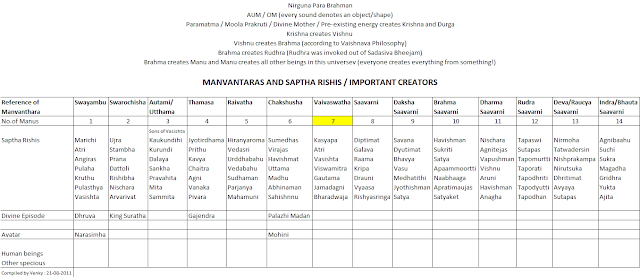
Please click the picture for the expanded format. This is quite important and valuable information for our generation to know our ancestors and source of human beings.
In the following manner, our galaxy and its beings were created.
God (Generation / Operation / Destruction) created everything and given to us as a gift.
1. Space / Akasa
2. Air / Vaayu
3. Fire / Agni
4. Water / Aapa
5. Earth / Prithvi
6. Plants / Aushada
7. Food / Annam
8. Soul / Jeeva
9. Action / Karma
Note: The One above is the reason for the later.

COSMOLOGICAL TIME FACTORS AND SANATHANA DHARMA
Please click to enlarge the file for detailed information about this subject. I wonder how excellent were our ancestors that includes all Rishis to precisely calculate and share it with us. The modern and scientific world will evently realise that our calculations and predictions were absolutely true, by the time the world will miss the target. At least whoever is interested, better to know such a valuable contributions of our greate Rishis who did all these selflessly for us.
I am happy to compile and give to you in a tabulated format so that you can use it frequently while discussing with others. Most of our our ancient theories are always dicussed and passed on to others rather than text book because what you heared systematically will stay long in your mind rather than text books.
Please make use of this table, you may print and circulate among your friends, at the end of the day many people should know about it, so that my time spent will be rewarded.
May God bless us
Venky

I am happy to compile and give to you in a tabulated format so that you can use it frequently while discussing with others. Most of our our ancient theories are always dicussed and passed on to others rather than text book because what you heared systematically will stay long in your mind rather than text books.
Please make use of this table, you may print and circulate among your friends, at the end of the day many people should know about it, so that my time spent will be rewarded.
May God bless us
Venky

Sunday, July 17, 2011
SPECIAL NIVEDHYAM/OFFERINGS FOR DEVI POOJA
According to Sri Devi Baghawatham, special Nivedhyam (offerings) have been prescribed for Sri Devi Pooja on different occations and timings, then offer the same to people, poors and devotees of Almighty. Please note the person who does Pooja and his family members must intake a portion of the same Nivedham food. The scientific meaning to it is that on these days if you consume the prescribed food it is good for health due to various combination of life and time confluence that reflect on our bodies. This does not mean that God want these types of food to bless Her devotees. In other words basically this is for our own welfare and healthy life in the name of God.
Please find attached the information which you may exercise in your life and enjoy the benefits. May God bless all.

Please find attached the information which you may exercise in your life and enjoy the benefits. May God bless all.

Subscribe to:
Posts (Atom)